Requena is a beautiful town in the interior of Valencia, largely known for its wine and cured meats. Although its best-known area is the historic center, it is not the only attraction it offers. Therefore, we are going to review what to see in Requena, in the three main neighborhoods of the city: Arrabal, Peñas, and Villa.
1. Arrabal
The Arrabal neighborhood is the backbone of Requena. It is located in the center of the town and is one of the liveliest and most vibrant areas. In it, we can find the following:
1.1 Avenida Arrabal
Avenida Arrabal is the main promenade. On Saturday mornings, a market is held here, and there are numerous bars and restaurants where you can stop to taste the typical gastronomy. It starts at Plaza del Portal, where the fountain, popularly known as Fuente de los Patos (Ducks’ Fountain), is located, and has an approximate length of one kilometer. Between two of its sections, you will find the Fuente de Colores (Colors’ Fountain).

1.2 Monumento Universal a la Vendimia (Universal Monument to the Grape Harvest)
It has been part of Avenida Arrabal since 1972, the year it was inaugurated. Since then, it has become one of the most representative images of Requena. It is an allegory to one of the most important activities in the region, the grape harvest, and for this reason, several of the most important events of the Grape Harvest Festival, celebrated at the end of August, take place around it.

1.3 Plaza de España
Here we can see some modernist buildings from the beginning of the 20th century, notably their balconies and facades. It is another of the main squares and acts as a nexus between the different neighborhoods.

1.4 Ayuntamiento (Town Hall)
It is located in Plaza Consistorial, where the Convent of Carmen, founded in the 13th century, was formerly situated. Next to the Town Hall, we find the Parque de la Glorieta, one of the main parks, ideal for going with children.

1.5 Recinto Ferial (Fairground)
At the end of Avenida Arrabal, we find a large bridge that leads to the Fairground. Although it is an empty area for the rest of the year, during festivals, it is where the fair is located and where various events are organized. Furthermore, during the Cured Meat Fair, the different butcher shops are concentrated in its Multifunctional Building.

1.6 Other places
- Biblioteca Pública Municipal (Municipal Public Library): Since 1979, it has been located at number 13 on Avenida de Arrabal.
- Sala de Exposiciones Antiguo Mercado (Old Market Exhibition Hall): In the same section as the Municipal Public Library, it hosts temporary art exhibitions.
- Museo Municipal de Requena (Requena Municipal Museum): At the back of the Town Hall. It houses several exhibitions on the history and tradition of the municipality. Price: €2. Open from Tuesday to Saturday from 11:00 to 14:00.
- Iglesia del Carmen (Church of Carmen): Next to the Municipal Museum, on Calle Carmen. It was built between the 13th and 16th centuries. To this day, it remains a place of worship.
2. Peñas
The Peñas neighborhood was formed after the Reconquest, when the Muslims were expelled from the Villa. Since then, a neighborhood of laborers began to develop. In its streets, mainly slopes, you can find some houses with coats of arms.
2.1 Teatro Principal (Main Theater)
If its enormous size is already visible from the outside, its elegance and majesty impress on the inside. Since 1952, it has hosted plays, events, concerts, and, to this day, cinema. Next to it, you can see a large mural, but it is not the only one in all of Requena.

2.2 Estación de Viticultura y Enología (Viticulture and Enology Station)
In Plaza Valentín García, we find this beautiful building, also with a modernist aesthetic. Since 1911, this place has maintained its activity related to vineyards and enology. Next to it is a bust of Rafael Janini, an illustrious director of this institution between 1919 and 1924.

2.3 Iglesia de San Sebastián (Church of San Sebastián)
It is a temple with a long history, as it was built in the 14th century in a Mudejar style. San Sebastián is the patron saint of this neighborhood, so it is a very important church for the inhabitants of its streets.

2.4 Others
- Centro de Juventud (Youth Center): It is located on Calle San Fernando, in what was formerly the Church of the Fathers of the Heart of Mary.
3. Villa
This is the oldest neighborhood in Requena and where a large part of the city’s attractions are concentrated. Different cultures have passed through it, leaving their mark to this day.
3.1 Iglesia de Santa María (Church of Santa María)
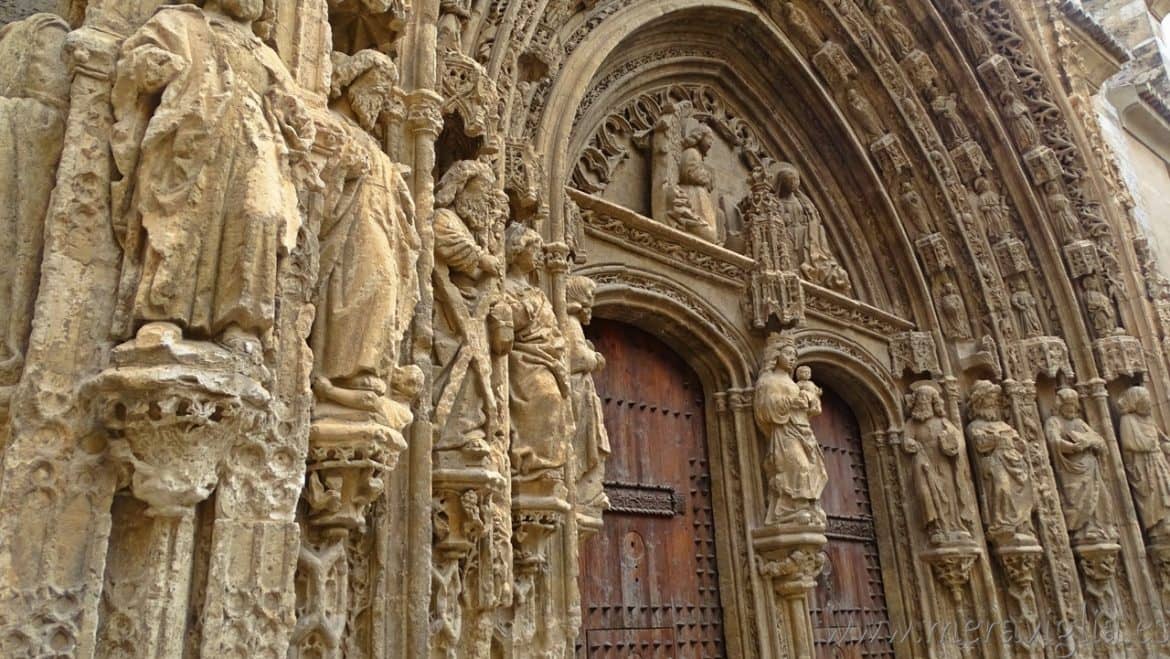
It stands out for its facade. It was built in the 14th century and is of Isabeline Flamboyant Gothic style, although its interior is Baroque. Currently, after a renovation, it functions as an exhibition and concert hall.

3.2 Iglesia del Salvador (Church of El Salvador)
This three-nave church was built between the 14th and 16th centuries, and its facade is also of Isabeline Flamboyant Gothic style. It continues to function as a place of worship. Its bell tower also stands out.

3.3 Iglesia de San Nicolás (Church of San Nicolás)
It is the oldest church in Requena, dating from the 13th century. It was completely renovated a few years ago, as it was in a great state of deterioration. Masses are not held here, but its interior can be visited, although the schedule varies. It costs €2 (€1.5 for reduced admission).

3.4 Plaza del Coronel Albornoz (Colonel Albornoz Square)
It is the main square of this neighborhood and is popularly known as Plaza de la Villa. It is a place of great beauty, with views of the churches of El Salvador and Santa María. Here you will find several hotels and restaurants.

3.5 Cuevas (Caves)
This is a must. Although not visible at first glance, the Villa neighborhood is full of caves of Arab origin. Many of the houses still preserve them: if you look closely, many of them, close to the ground, have a small window, which serves to ventilate them. A good part of these caves were joined and can be visited.
You enter them through Plaza del General Albornoz. Admission costs €4 (€3 reduced) and the visit is done with an audio guide. Its opening hours are Tuesday to Sunday from 11:00 to 14:00 and from 17:00 to 20:00.

3.6 Torre del Homenaje (Homage Tower)
It crowns the Villa, so it can be seen from a large part of the city. It was built by the Arabs in the 10th century. You can access it by paying an entrance fee of €2 (€1.5 reduced price) and it opens from Tuesday to Sunday, although the schedule may vary. It is next to the Patio de Armas (Parade Ground), where open-air festivals and concerts are sometimes organized.

3.7 Museo de Arte Contemporáneo Florencio de la Fuente (Florencio de la Fuente Museum of Contemporary Art)
It is located in a beautiful building characterized by its balconies that can be seen from Cuesta del Ángel. The exhibitions in this museum are temporary, and works by Sorolla, Dalí, and Miró, among others, have passed through here. Admission costs €2 (€1.5 for reduced admission), and its opening hours vary.

3.8 Others
- Casa Museo de la Seda (Silk House Museum): On Calle del Castillo. It is an interesting museum about the history of silk in Requena. Admission costs €3, and visits can be arranged by calling +34 697 10 48 24 or +34 96 230 38 54.
- Palacio del Cid (Cid Palace): A large house converted into the Wine Museum. It is located at Calle Somera, 13, and admission costs €2.
- Museo Fiesta de la Vendimia (Grape Harvest Festival Museum): A museum dedicated to Requena’s most important festival: the Grape Harvest Festival. It is located at Calle Santa María, 41, and costs €2. Its hours are Wednesday to Saturday from 11:00 to 14:00 and from 17:00 to 20:00, and Sundays from 10:30 to 14:00.

Furthermore, it is also recommended to visit a winery to learn about the wine-making process of the Utiel-Requena D.O. and, of course, taste it. For example, you can book a visit to the Sierra Norte winery.
As you can see, Requena has numerous attractions, making it a good destination for a quiet weekend. In it, you will enjoy the narrow alleys of the Villa, the life of the Arrabal neighborhood, and the tradition of the Peñas.
Related Article: Free Places to Visit in Valencia: Museums and Monuments
No responses yet